Automation for Multi-Location Businesses: Connecting Systems and Operations
Connect branch data, shared requests and enterprise reporting without erasing local ownership or legal-entity boundaries.

Multi-location business automation connects shared processes across branches while preserving the context each location needs. Central information is useful only when local records, legal entities and access rules remain accurate. The objective is coordinated operation, not one unrestricted database or dashboard that hides differences between sites.
Identify what must be shared and what must remain local
Branches may use different item codes, customer records, approval paths and reporting cutoffs. Central management cannot compare operations reliably when a completed task or available unit means something different at each site. A new interface will not resolve those definitions automatically.
Map the shared process and identify its location, legal entity, record owner and permitted readers. Decide which fields are centrally governed and which teams own local updates. ERP and CRM integration should make those ownership rules explicit before synchronization begins.
Connect common workflows deliberately
CRM integration can coordinate account context and route a request to the appropriate branch. ERP workflows can connect purchasing, inventory and financial records according to entity rules. Shared request management can assign an owner, track the responsible site and escalate overdue work without creating several conflicting tickets.
Consolidated reporting needs common metric definitions and source timestamps. Inventory visibility should distinguish stock on hand, reservations and transferable availability. An item visible at another location is not necessarily authorized for sale or transfer under the current operating rules.
A branch-to-enterprise workflow
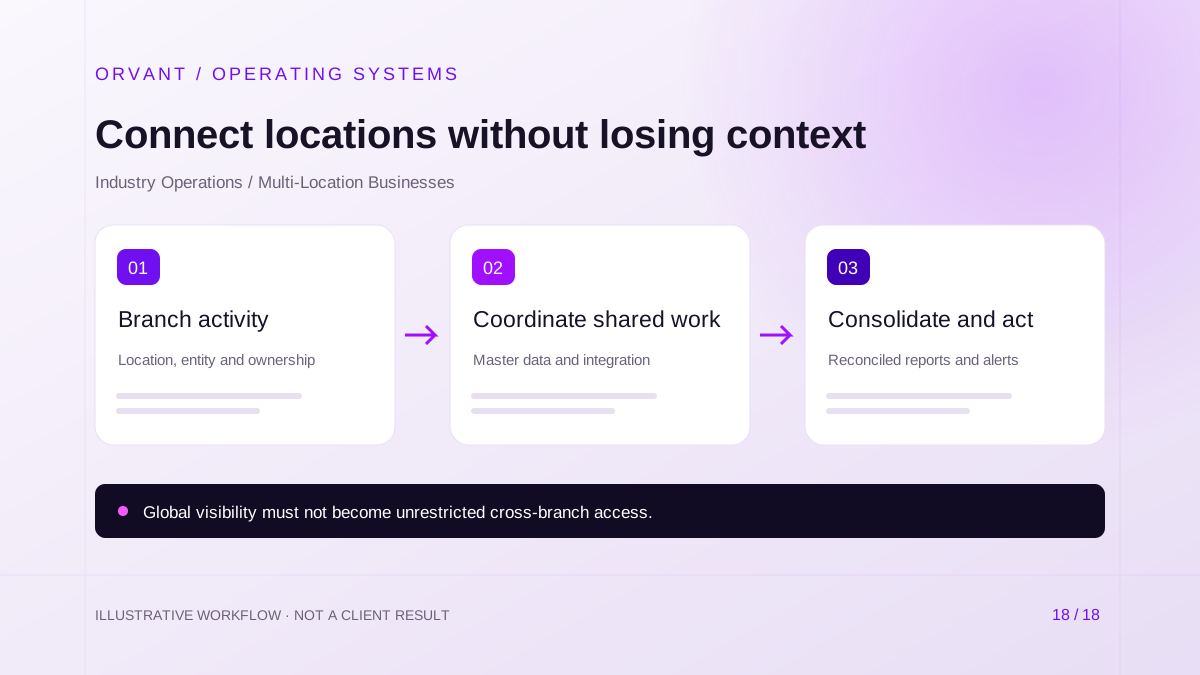
- Capture the event with a stable identifier, location, legal entity and responsible team. Validate the shared identifiers and required local context.
- Apply the defined synchronization or approval rules. Create linked tasks or transactions in the relevant systems rather than overwriting records across every site.
- Reconcile the result and update permitted consolidated reporting. Keep unresolved exceptions visible to both the local owner and the central team responsible for the handoff.
Microsoft's intercompany order documentation illustrates linked purchasing and sales transactions between entities. A cross-branch workflow must first determine whether it is also an intercompany transaction; the two situations are not interchangeable.
Hypothetical scenario: fulfilling a request from another branch
For example, a customer asks one branch for an item that another location may hold. The workflow checks the permitted inventory view, validates the unit and ownership context, and creates a transfer or fulfillment review task under the company's rules.
The receiving branch confirms availability and the authorized route. If a linked transaction fails, the original request remains pending and a named team resolves it. The system does not promise availability from a stale report or move stock merely because a central assistant found a matching description.
Alerts and reporting need accountable owners
An overdue-request alert should identify the source event, site, threshold and expected action. Give managers a way to distinguish local delay from a failed integration. Escalation should follow operating responsibility rather than distribute every alert to every branch.
For management reporting, reconcile source totals and identify incomplete feeds. Keep local time zones and accounting cutoffs in view. AI business intelligence can help explain governed information, while logistics and distribution automation addresses fulfillment-specific handoffs.
Requirements across sites and legal entities
Establish master-data stewardship, identity federation, role mappings and retention rules. Plan for a disconnected branch or a delayed event feed. Central administrators should not receive unrestricted access to employee or client records simply because a shared process spans locations.
Budget for connector differences, migration cleanup, site-level testing, rollout support and ongoing maintenance. A configuration change at one branch can break a shared assumption. Assign owners for both the common workflow and local exceptions, with a clear rollback and recovery plan.
Evaluate one shared process before a broad rollout
Pilot a process across a small, representative set of sites. Include different working hours, inconsistent records, duplicate events and permission differences. Measure reconciled completion, manual handoffs, unresolved exceptions and the time local teams spend correcting errors.
Potential benefits include clearer status and less repeated entry, but centralization can also create a shared point of failure. Test how branches continue operating during an outage and how records reconcile afterward. Success means a more dependable operating process, not simply more data in one place.
Common questions
Does every branch need the same software?
Not necessarily. Supported interfaces and shared data contracts may connect different systems. Standardization should follow actual requirements and the cost of maintaining the alternatives.
Can central reporting ignore entity differences?
No. Entity ownership, currency, accounting definitions and permitted access can affect how records should be combined. Reconciliation rules must reflect those differences.
When should we discuss custom development?
Consider custom enterprise software when the organization needs a common review and exception workflow that existing tools cannot provide. Bring one cross-location process and its ownership boundaries to the first consultation.
Sources and further reading
Official references checked on October 28, 2026. These describe capabilities or considerations, not results achieved by ORVANT.
- Microsoft: Intercompany purchase and sales orders
Documents linked transactions across separate company entities.
Discuss the workflow behind your next improvement.
Bring your current process, system dependencies and operating constraints. We can discuss scope, feasibility, review controls and a practical pilot.
Discuss Your Project