AI Business Intelligence: Turning Enterprise Data Into Actionable Insights
Build source-grounded answers, governed metrics and department-level access into an enterprise knowledge and reporting workflow.

AI business intelligence gives authorized users a more convenient way to ask questions about enterprise information. It can combine governed metrics, source retrieval and explanations, but it does not automatically make disconnected or contradictory records trustworthy. The foundation is a clear definition of what the business means by each answer.
Begin with a decision and its evidence
A COO asking why a backlog grew needs more than a plausible paragraph. The answer may depend on order status, staffing, request categories and incomplete handoffs across applications. If different teams define a completed order differently, an assistant can make the disagreement less visible while sounding confident.
Choose a decision, identify its permitted sources and agree on the relevant definitions. Separate live transactional data, historical reporting tables and policy documents. Assign an owner to each business metric and document its refresh schedule before creating a natural-language interface.
Use structured queries for numbers and retrieval for knowledge
Natural-language queries can be translated into a restricted set of approved queries or semantic-model measures. Validate parameters, apply access rules and show filters with the result. Do not ask a language model to estimate a revenue total from unrelated text snippets when a governed calculation exists.
Retrieval-augmented generation, or RAG, uses relevant documents to ground an answer. It suits policy, process and knowledge questions, provided the retrieved sources are current and authorized. Microsoft's document-level access guidance describes permission enforcement for retrieval; evaluate feature availability separately for the selected platform.
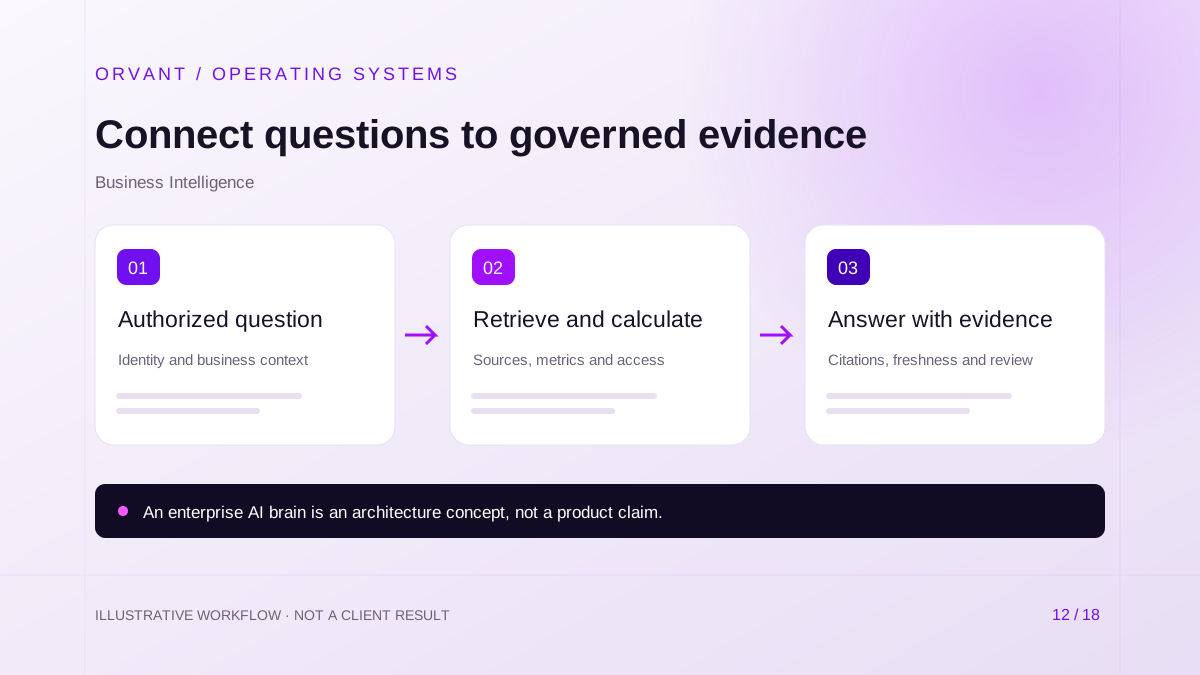
A permission-aware question-to-answer flow
- Authenticate the user and determine which sources, locations and departments the request may access. Preserve those restrictions throughout retrieval and calculation.
- Retrieve permitted documents or execute approved metric queries. Include source identifiers, timestamps, definitions and any missing inputs with the result.
- Produce a response that cites evidence, distinguishes observations from proposed explanations and declines unsupported questions. Log enough context to evaluate the result without copying unnecessary sensitive content.
Treat retrieved documents as untrusted input. Text inside a file must not authorize the assistant to change permissions, reveal another department's records or call an unrestricted tool. Enforcement belongs in the application and retrieval service, not merely in the assistant's instructions.
Hypothetical scenario: understanding an operations backlog
For example, an operations manager asks which request types are overdue. The system applies the agreed overdue definition to the manager's permitted locations and returns counts from the reporting model. It retrieves the relevant escalation procedure to explain the next approved step.
If the manager asks why performance changed, the response can show changes in request mix or completion timing as observations. It should not assert a causal explanation without evidence. Missing feeds or stale updates must appear as limitations, not disappear inside a polished management summary.
Reports, trends and alerts
Scheduled reporting can assemble verified figures and prepare a narrative draft for review. Trend detection can identify changes worth investigating. Indicator alerts should specify a threshold, owner, data freshness and expected response, otherwise they become another queue nobody manages.
Separate forecasting from actuals and describe uncertainty where a model is used. Business operations automation can connect a validated alert to a task, while multi-location automation addresses consolidation and local ownership.
What an enterprise AI brain would actually require
An enterprise AI brain is a useful architectural metaphor for connected organizational knowledge. It is not a claim that ORVANT already sells a finished product with access to every company system. A feasible implementation is a bounded set of sources, queries, permissions and workflows shaped around a defined need.
Plan identity integration, data contracts, semantic definitions, indexing, retention and monitoring. Budget for source cleanup, connector maintenance, model usage and evaluation. Add a way to revoke access and refresh changed permissions promptly; copying documents into an index must not erase their original boundaries.
Evaluate answers before expanding access
Prepare a test set with answerable, ambiguous, stale and unauthorized questions. Check source accuracy, citation support, calculation correctness and whether the assistant refuses out-of-scope requests. Include managers from different departments so permission tests reflect actual roles.
Measure analyst preparation time, correction effort and the usefulness of the resulting decision support. A quicker answer that uses the wrong definition is not an improvement. Test again after a source, permission model or retrieval configuration changes.
Common questions
Can RAG eliminate inaccurate answers?
No. Retrieval can return irrelevant or outdated material, and a model can still misinterpret it. Source references, evaluation and appropriate refusal behavior remain necessary.
Should all employees see the same information?
Not necessarily. A common interface can serve different roles while applying different source and metric access. Global search must not become unrestricted access to confidential files.
How should we start?
Bring one management question and its underlying systems to an enterprise AI consultation. Start with governed answers for that decision, then expand only when the evidence and permissions support it.
Sources and further reading
Official references checked on October 28, 2026. These describe capabilities or considerations, not results achieved by ORVANT.
- Microsoft: Document-level access control in Azure AI Search
Reference for permission-aware retrieval; preview features need separate production assessment.
Discuss the workflow behind your next improvement.
Bring your current process, system dependencies and operating constraints. We can discuss scope, feasibility, review controls and a practical pilot.
Discuss Your Project