Business Automation for Logistics and Distribution Companies
Design order, warehouse, delivery and billing handoffs as a connected process, with reconciliation across sites and systems.

Logistics business automation connects the operational chain from order acceptance to warehouse execution, delivery evidence and billing. Its central problem is coordination between systems and teams, not necessarily a lack of AI. A dependable design makes each business state explicit and reconciles the handoffs before presenting the work as complete.
Map the order-to-cash chain across systems
A distributor may receive an order in CRM, reserve inventory in ERP, execute work in a warehouse system and obtain delivery events from a carrier. Staff fill gaps with spreadsheets when identifiers, quantities or statuses do not match. These workarounds can obscure whether the order is actually ready to bill.
Document the sequence, source of truth and responsible owner for each step. Include split shipments, returns, substitutions, damaged goods and partial receipts. Begin an ORVANT business automation project with this process contract rather than a list of applications to connect.
Assign each system a clear responsibility
The sales or order system may own the commercial order, the warehouse system may own execution, and the ERP may own financial records. Confirm those roles in the actual environment. Microsoft's warehouse management with external ERP documentation illustrates the need to define integration boundaries explicitly.
Map customer, item, unit, warehouse, legal entity and transaction identifiers. Keep an accepted order separate from an allocation, a pick, a dispatch and a delivery confirmation. A general status labeled complete can hide important differences between departments.
Design an event-driven fulfillment workflow
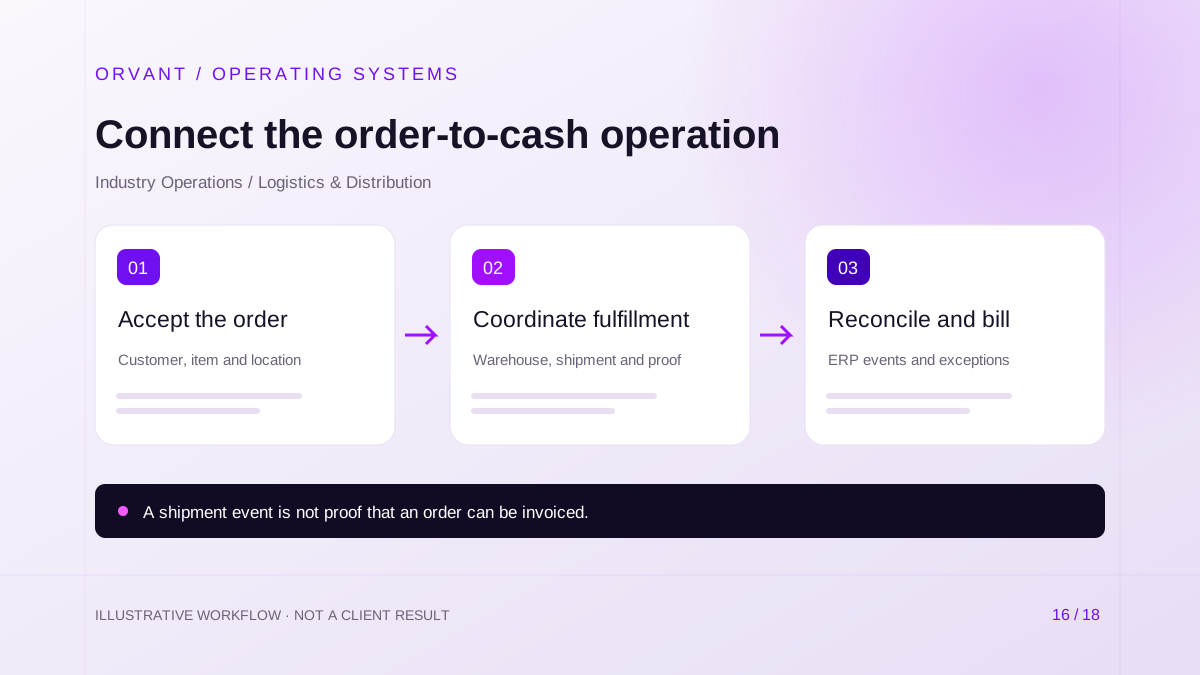
- Validate the order and associate its authoritative customer, item and location records. Return incomplete or incompatible requests to the responsible team.
- Coordinate inventory allocation and warehouse execution through supported interfaces. Correlate each event with the order line and shipment rather than only with the order header.
- Reconcile dispatch and delivery evidence, then prepare billing when the agreed commercial rules are met. Route short shipments, returns and missing proof to a visible exception queue.
Use idempotency controls so repeated events do not create duplicate shipments or invoices. Retain event times and processing times separately: a carrier message received late may describe an earlier event. Test the recovery path when only one system accepted a transaction.
Hypothetical scenario: a split order across warehouses
For example, a distributor fulfills an order from two warehouses. The first shipment arrives while the second is delayed. The workflow tracks quantities and proof of delivery by line and shipment, then creates the appropriate finance review task under the company's billing rules.
It does not mark the entire order delivered after the first carrier event. A customer-service agent can see what remains outstanding without reconstructing the chain from separate dashboards. The finance team receives the evidence needed for its decision rather than an unsupported complete flag.
Where AI can help, and where it is unnecessary
AI may extract fields from unstructured orders, classify delivery notices or prepare a summary of a disruption. Known stock movements and accounting entries generally need validated transactions, not generated guesses. Prefer rules and APIs when the event and action are already defined.
The AI logistics guide focuses on forecasting, document interpretation and exception analysis. This industry guide covers the operating chain that must remain coherent regardless of whether those AI capabilities are used.
Requirements across warehouses and locations
Agree on master-data ownership, timestamp conventions, reconciliation frequency and who handles each exception. Define business continuity when a warehouse or carrier feed is unavailable. Limit access by site and legal entity where required, while giving central operations the visibility it is authorized to use.
Budget for integration adapters, data cleanup, testing, monitoring and operating support. Interface upgrades and warehouse configuration changes can affect the workflow. Multi-location automation addresses shared processes across sites, while procurement automation connects replenishment to purchasing controls.
Evaluate the process, not just message throughput
Pilot one order type and a limited system path. Measure manual handoffs, unmatched events, inventory discrepancies, billing exceptions and time to resolve partial failures. Reconcile a sample back to each system of record instead of relying only on integration logs.
Potential benefits include less repeated entry and a clearer view of unfinished work. A high rate of successful API calls does not establish that customers received the correct goods or that finance can close the order. Include correction and maintenance effort in the business case.
Common questions
Do we need to replace our ERP or warehouse system?
Not necessarily. Supported integration and clearer process ownership may solve the problem. Assess replacement only against requirements that the existing environment cannot reasonably meet.
Can a shipment automatically trigger an invoice?
Only under the organization's defined commercial and finance rules, with reliable reconciliation. Dispatch, delivery and invoice eligibility are different events.
When is custom development appropriate?
Consider custom enterprise software when the required review and exception workflow spans systems that existing configuration cannot coordinate adequately.
Sources and further reading
Official references checked on October 28, 2026. These describe capabilities or considerations, not results achieved by ORVANT.
- Microsoft: Warehouse management with external ERP
Illustrates system responsibilities and integration boundaries in warehouse operations.
Discuss the workflow behind your next improvement.
Bring your current process, system dependencies and operating constraints. We can discuss scope, feasibility, review controls and a practical pilot.
Discuss Your Project