Procurement Automation With AI: Streamlining Purchasing Workflows
Organize supplier information, compare quotations and route purchase requests through budget checks and auditable approval paths.

AI procurement automation helps purchasing teams organize requirements, interpret supplier documents and prepare comparisons. It works best inside an established purchasing workflow with explicit approval limits and ERP records. Reading a quotation faster is useful only if the resulting request is complete, comparable and authorized before a purchase order is issued.
Identify where purchasing work becomes ambiguous
Procurement teams may receive incomplete requests, quotations with different units and supplier documents stored in separate folders. Reviewers spend time checking what is actually being purchased and whether a price includes freight, tax or another charge. The cheapest visible number may not represent the same scope.
Map request intake, sourcing, review, approval and order creation. Document required information, budget ownership and supplier-master controls. An ERP and CRM implementation should connect those responsibilities rather than create a second ungoverned purchasing record.
Automate preparation, not purchasing authority
AI can classify a request, extract agreed quotation fields and highlight missing terms. Rules can check whether required documents are present, select the approval path and track overdue reviews. Supplier information can be organized against stable vendor identifiers without treating every new email attachment as a verified master-data change.
Comparisons need explicit fields: item specification, quantity, unit, currency, delivery conditions, payment terms and exclusions. Where an offer is ambiguous, show the source passage and ask for clarification. Do not silently normalize a term that materially changes what the supplier is offering.
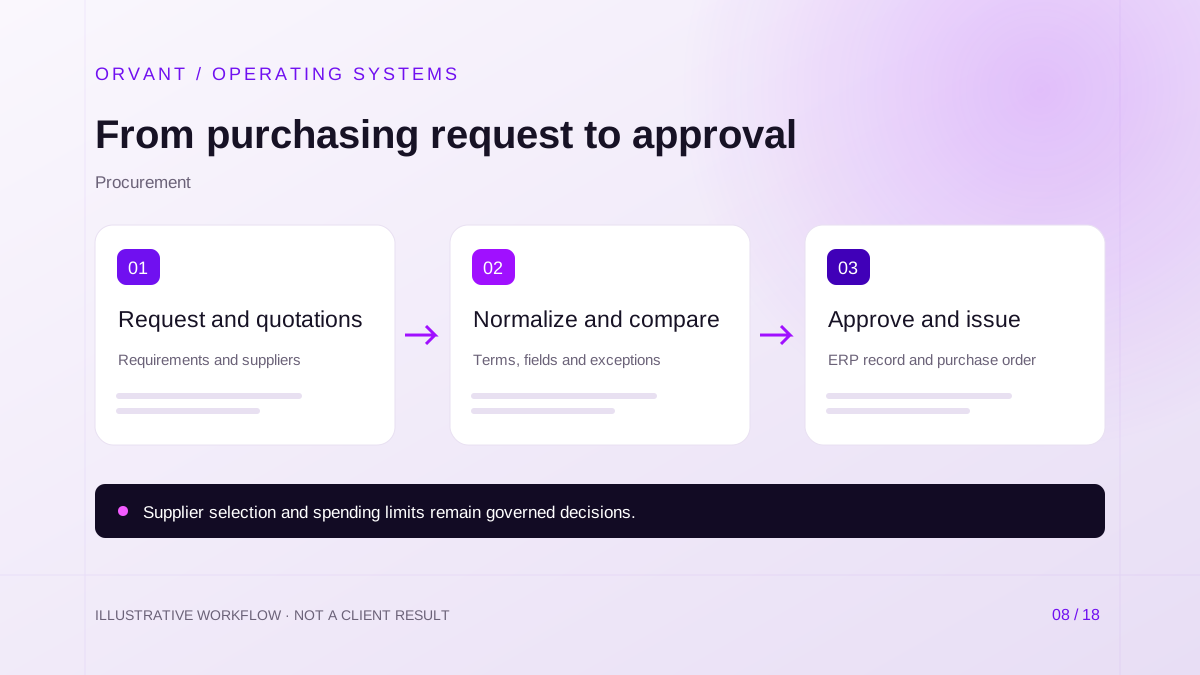
A request-to-purchase-order workflow
- Capture the purchase request with its business purpose, requested items, location and responsible budget owner. Return incomplete requests to the requester with a specific reason.
- Extract quotation details, check vendor records and prepare a comparable review package. Route discrepancies and missing terms to the buyer rather than forcing a complete-looking table.
- Apply the approval workflow and create the purchase order through the ERP after authorization. Reconcile the created order with the approved request and retain its attachments.
Microsoft's purchase requisition workflow documentation illustrates that review can occur at document or line level. Select the structure that matches the actual business; not every item in a request necessarily has the same approver.
Hypothetical scenario: comparing equipment quotations
For example, an operations team requests equipment for a new location. One supplier quotes each unit, another quotes a package, and a third excludes installation. The workflow extracts the known fields and presents missing or incompatible terms beside the original documents.
The buyer confirms the scope and records the reason for selection. A manager approves the relevant budget. The system then creates an ERP order with the approved line items. An AI-generated recommendation cannot substitute for the organization's supplier due diligence or spending authority.
Preserve approval and supplier controls
Separate vendor onboarding, changes to bank details, source comparison and final purchasing approval. A document-processing account does not need authority to alter payment information. Treat instructions embedded in supplier documents as content to analyze, not as commands to execute.
Version the review package so an amended quotation does not silently replace what was approved. Keep a route for emergency purchases with the organization's own documented controls. Accounting automation depends on this upstream evidence when an invoice is later matched to a purchase order.
Implementation requirements and costs
Prepare representative quotations, item identifiers, supplier records, approval rules and ERP interface access. Define which values are authoritative and how duplicate or conflicting records are resolved. AI document processing can support extraction, but its output still needs purchasing-specific validation.
Budget for integration, document handling, licenses, buyer review and maintenance of mappings. Supplier templates and purchasing policies change. Name a process owner who can update validation rules and monitor requests that remain unresolved after an integration error.
Evaluate a controlled pilot
Start with one purchasing category whose specifications and approvals are reasonably consistent. Compare preparation time, missing-information rates, corrected fields and approval cycle time against the current process. Include the buyer's effort to repair a misleading comparison.
Test amended quotations, different currencies, mixed units, duplicate requests and failed ERP writes. A successful pilot should make the approved decision easier to reconstruct, not just make the first draft faster. Potential benefits include clearer comparisons and fewer avoidable handoffs; savings depend on actual purchasing behavior and cost.
Common questions
Can AI choose the winning supplier?
It can summarize agreed comparison criteria, but the designated buyer should review the evidence and make the decision. Important commercial or compliance considerations may not be present in the documents.
Should every purchase request use AI?
No. A structured catalog request may need only rules and an approval workflow. Use AI when document variation or free-text interpretation is the actual bottleneck.
What should ORVANT assess first?
Bring a real request-to-order process with redacted example documents, approval boundaries and ERP dependencies. Define a limited preparation workflow before expanding into supplier management or payments.
Sources and further reading
Official references checked on October 28, 2026. These describe capabilities or considerations, not results achieved by ORVANT.
- Microsoft: Purchase requisition workflow
Shows document- and line-level review and approval workflows.
Discuss the workflow behind your next improvement.
Bring your current process, system dependencies and operating constraints. We can discuss scope, feasibility, review controls and a practical pilot.
Discuss Your Project