AI in Accounting: Automating Financial Workflows and Document Processing
Map invoice intake, extraction and reconciliation preparation around ledger controls, evidence and accountable finance review.

AI accounting automation can prepare financial work by extracting invoice fields, organizing documents and identifying items that need attention. It does not replace ledger controls, payment authority or professional accounting judgment. A useful implementation shortens preparation while leaving approvals, evidence and exceptions visible to the finance team.
Identify the expensive manual handoff
Accounts payable often receives documents through several inboxes and portals. Staff check supplier details, identify a purchase order, interpret line items and ask another team whether goods were received. The delay may come from missing approvals or inconsistent master data rather than document reading alone.
Map invoice intake through posting and payment, recording where evidence originates and who approves each step. Separate preparing a proposed transaction from authorizing it. ERP implementation and integration should preserve that distinction instead of giving a document model direct posting authority.
What can be automated responsibly?
Invoice processing can extract supplier names, dates, identifiers, amounts and line items into a proposed record. Microsoft's invoice processing documentation describes structured extraction; actual performance still needs testing on the organization's files. Classification can propose expense categories, but finance must define the chart-of-accounts mapping and ambiguous cases.
Reconciliation preparation can match known transaction identifiers and present discrepancies. Anomaly detection can flag unusual patterns for investigation, not establish misconduct. Document workflows can associate approvals and supporting files with a record. Reports can assemble verified ledger data, while any narrative explanation remains reviewable.
From document to reviewable entry
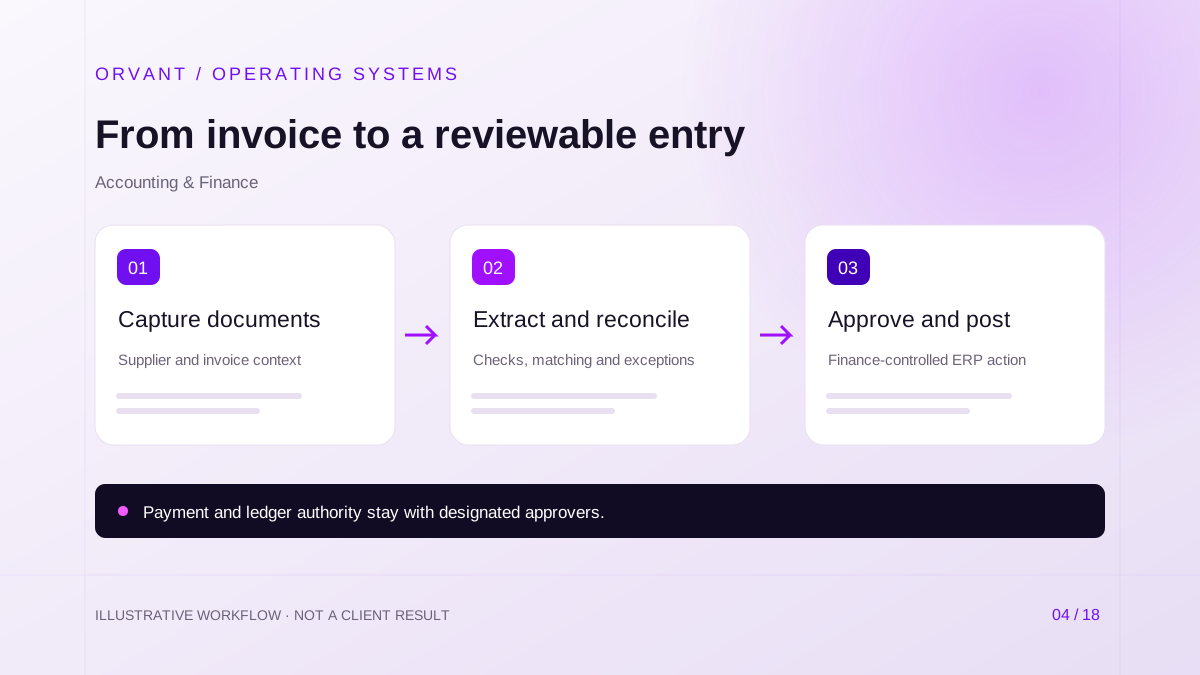
- Capture the invoice, retain its source reference and check for duplicates using more than a file name. Confirm the relevant company, supplier and document type.
- Extract agreed fields and validate arithmetic, required identifiers, currency and purchase-order matches. Compare receiving evidence when the process requires it; route mismatches to a reviewer.
- Present a proposed accounting entry with the source document and validation results. An authorized person approves posting through the ERP's normal controls.
Keep transaction IDs through retries. A missing receiving record should create a visible exception, not an invented match. Preserve reversals and correction history so the workflow can be reconciled against the ledger.
Hypothetical scenario: invoices across two entities
For example, a group receives similar supplier invoices for two legal entities. The workflow identifies the billed entity, retrieves its purchase order and checks whether the invoice currency matches the relevant record. An otherwise plausible invoice goes to review when the entity or bank details conflict.
The system can prepare a reconciliation worksheet while the accountant determines whether a mismatch is a timing issue, a duplicate or an actual error. It must not pay an invoice simply because extraction confidence is high. Model certainty about a field and authority to spend are different controls.
Protect financial information and approvals
Restrict access by entity and role. Avoid including bank details or unnecessary personal information in general application logs. Confirm vendor handling, retention and deletion behavior before using financial documents with a hosted model. Audit the service account's access separately from a reviewer's permissions.
Bank-detail changes, exceptions to payment policy and final financial reporting deserve explicit human review. A general-purpose model should not become an undocumented accounting policy engine. See procurement automation for how purchasing approvals and supplier records affect downstream finance work.
Implementation requirements and total cost
Useful inputs include representative scans, credit notes, varied invoice layouts and examples of previously disputed documents. Finance should own validation rules and correction labels. Integration work must address tax and currency fields, accounting periods, entity mappings and closed-period restrictions as applicable to the actual ERP configuration.
Budget for extraction usage, document storage, licenses, reconciliation work, model evaluation and ongoing maintenance. A shorter processing time can be offset by an expensive exception queue. The business operations guide explains how to evaluate an entire process rather than a single task.
Measure a finance pilot
Run the workflow against historical examples with approved outcomes before posting anything. Measure field-level correctness, duplicate detection, exception accuracy and reviewer handling time. Test low-quality images, missing pages, conflicting totals and unavailable ERP connections.
Begin with draft records or a review queue. Compare end-to-end preparation and approval time against the baseline, including corrections. Potential benefits include reduced re-entry and more traceable work; neither a particular savings percentage nor error-free accounting follows automatically.
Common questions
Can extracted invoices be posted without review?
Only consider straight-through handling for a carefully bounded, validated process with authorization controls and an exception route. Introducing AI is not itself a reason to remove approvals.
Is anomaly detection proof of fraud?
No. It identifies records needing investigation. Explain the trigger and retain source evidence without presenting an automated flag as a final conclusion.
What is a useful first project?
Choose one document type and one entity, with known validation rules. An ORVANT automation consultation can assess the preparation workflow before broader financial integration.
Sources and further reading
Official references checked on October 28, 2026. These describe capabilities or considerations, not results achieved by ORVANT.
- Microsoft: Invoice processing model
Describes invoice extraction capabilities; suitability must be evaluated on actual documents.
Discuss the workflow behind your next improvement.
Bring your current process, system dependencies and operating constraints. We can discuss scope, feasibility, review controls and a practical pilot.
Discuss Your Project