AI in Logistics: Automating Inventory, Orders and Supply Chain Workflows
Evaluate forecasting, shipment exceptions and document interpretation while keeping stock, delivery commitments and dispatch authority grounded in operational systems.

AI logistics automation applies interpretation and prediction to operational information: incoming orders, inventory signals, shipment documents and delivery exceptions. Its role differs from the transaction system that records stock or authorizes dispatch. A useful project connects the two without presenting a forecast, extracted field or carrier message as an unquestionable business fact.
Locate the uncertainty in the logistics process
Orders may arrive as structured records, emails or attachments. Planners compare them with stock, supplier lead times and carrier events. Teams often spend time interpreting inconsistent information before they can decide whether a shipment needs attention.
Separate those interpretation tasks from deterministic warehouse and ERP transactions. If the main problem is moving known data between applications, integration may be the right solution. The logistics and distribution industry guide addresses that end-to-end orchestration; this guide focuses on where AI adds useful interpretation or prediction.
Specific applications to evaluate
Order intake can extract agreed fields from customer documents and compare them with item and address records. Delivery monitoring can group carrier exceptions and propose which team should investigate. Document processing can associate packing lists, bills of lading and proof-of-delivery records with the right shipment.
Inventory alerts can combine fixed thresholds with demand estimates. Forecasting can help planners assess possible demand patterns, while route optimization evaluates explicit capacity, time and service constraints. These tasks need different models and evaluation methods; a language model that summarizes a delay is not automatically a demand forecaster or routing optimizer.
Build an evidence-to-action workflow
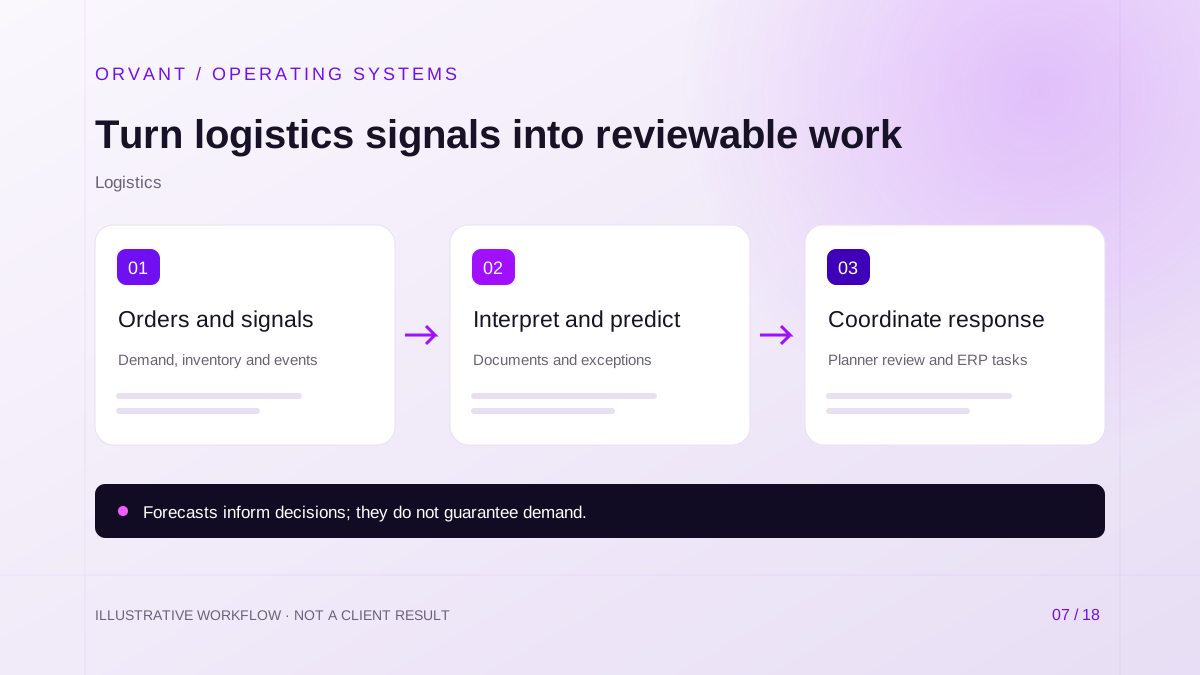
- Ingest permitted order and shipment events, retaining timestamps, source identifiers and location context. Check for duplicates and late-arriving events.
- Extract, classify or forecast within a defined scope. Compare the result with ERP or logistics records and mark missing, conflicting or uncertain inputs.
- Create a reviewable planning recommendation or exception task. Execute stock, dispatch and customer-commitment changes only through authorized controls.
Connect the relevant ERP, warehouse management and transportation systems through supported contracts. Define the authoritative record for inventory, shipment status and promised date. A carrier's latest event must not overwrite a confirmed warehouse receipt without reconciliation.
Hypothetical scenario: delivery exceptions
For example, a distributor receives differently worded delay notices from several carriers. The workflow associates each notice with a shipment, classifies the stated issue and checks whether the promised date may be affected. It prepares a task with the source notice and relevant order context.
A planner decides whether to contact the carrier, offer an alternative or inform the customer. If the shipment cannot be matched, the notice enters an unmatched-events queue. The system does not generate an invented ETA to make the dashboard appear complete.
Forecasting and route planning require operational constraints
Demand estimates depend on relevant history, availability and business changes. Stockouts can distort observed sales; promotions or new locations can make older patterns less representative. Microsoft's demand planning overview provides a product example of forecasting combined with planner collaboration.
For route planning, specify vehicle limits, delivery windows, driver constraints and service requirements. Evaluate travel estimates against actual operating conditions. Keep override reasons and planner decisions so that later analysis distinguishes a poor recommendation from a deliberate business exception.
Data, permissions and maintenance requirements
The implementation needs stable item and location identifiers, unit-of-measure mappings, usable timestamps and access to representative documents. Plan retention and access for customer addresses and carrier records. Do not place sensitive delivery details in general analytics events.
Include data cleanup, integration support, model evaluation and planner training in the budget. Vendor feeds change and outages occur, so keep the last confirmed business state separate from a pending interpretation. Procurement automation can help connect replenishment tasks without bypassing purchasing approvals.
Evaluate the pilot using the right baseline
Choose a single lane, document type or exception category. For extraction, measure correct fields and matching quality. For forecasting, compare with an appropriate simple baseline and assess performance by item and horizon. For exceptions, measure whether useful issues reach the correct owner in time.
Track the planner's review and correction effort as well as processing time. Potential benefits include less manual interpretation and earlier attention to disruptions; neither accurate forecasts nor on-time delivery can be guaranteed by the automation itself.
Common questions
Can AI automatically replenish stock?
It can support a replenishment proposal, but approval, inventory policy and ERP transaction controls must be defined. Begin with reviewed recommendations before considering tightly bounded autonomous actions.
Is route optimization the same as a chatbot?
No. Routing requires a model of constraints and an optimization method. A conversational interface may explain a plan, but it is not the underlying scheduling engine.
When is custom software useful?
Consider custom enterprise software when several systems must share a reviewable logistics workflow and existing configuration cannot support the required operating rules.
Sources and further reading
Official references checked on October 28, 2026. These describe capabilities or considerations, not results achieved by ORVANT.
- Microsoft: Demand planning overview
Reference for forecasting and planner collaboration, not a promise of forecast accuracy.
Discuss the workflow behind your next improvement.
Bring your current process, system dependencies and operating constraints. We can discuss scope, feasibility, review controls and a practical pilot.
Discuss Your Project