AI Sales Automation: How Businesses Can Streamline Their Sales Process
Separate lead capture, qualification and seller judgment. Design follow-up workflows that preserve context and make the next action clear.

AI sales automation supports the administrative and research work between a business inquiry and a seller's next decision. It can organize incoming leads, prepare qualification evidence and keep CRM records current. It should not turn a weak behavioral signal into a promise that someone will buy, or make commercial commitments that the sales team has not authorized.
Diagnose where opportunities lose context
Leads often move through web forms, event lists, email inboxes and calendars before a seller sees a useful record. Duplicate contacts obscure ownership. An incomplete CRM entry can trigger the wrong follow-up, while an unrecorded conversation makes an opportunity appear inactive.
Map those failures before introducing scoring. Capture the information already available, the fields a seller actually needs and the point where responsibility changes. ERP and CRM integration may solve more of this problem than an additional AI tool when the underlying records do not synchronize.
Separate fit, intent and qualification
Fit describes whether the organization matches the service offered: operating needs, company context and implementation constraints. Intent concerns evidence of a current project, such as a stated integration problem or a request to discuss scope. Qualification is a seller's assessment of whether the conversation should proceed.
A score can summarize signals, but it should retain its reasons and uncertainty. Do not treat an email open as proof of intent or infer purchasing authority from a job title alone. Microsoft's Sales Qualification Agent overview describes research and engagement modes while retaining seller judgment; these are distinct implementation choices, not one mandatory automation level.
Design the lead-to-opportunity flow
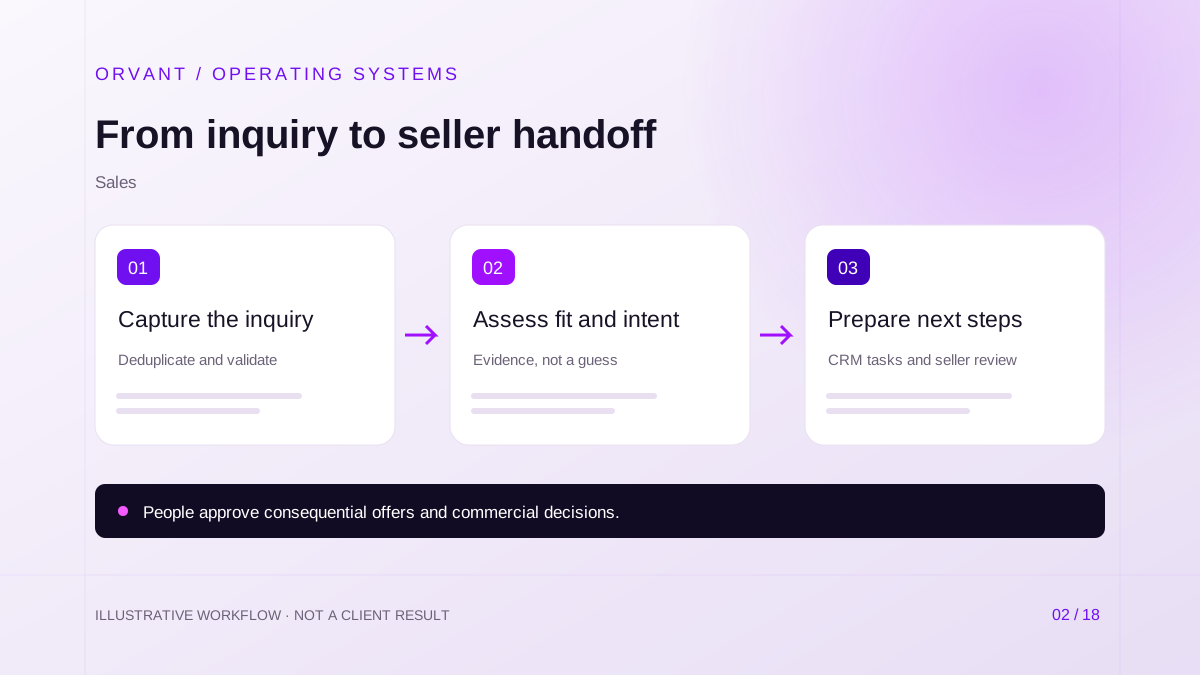
- Receive the inquiry, validate required fields and deduplicate against permitted CRM identifiers. Preserve campaign attribution separately from the person's message.
- Extract the stated problem, existing systems and requested timeline into reviewable fields. Flag missing evidence rather than manufacturing a budget, employee count or project deadline.
- Assign an owner, prepare a research summary and create the next task. A seller reviews qualification before opening an opportunity or making a proposal.
Use stable record IDs and explicit synchronization rules. The CRM should remain the source of truth for ownership and opportunity stage. Retry failed writes safely and show the seller when a summary was generated from incomplete or stale information.
Follow-up, proposals and meetings
Rules can schedule an approved follow-up after a missed response, suppress it after an opt-out and stop it when an opportunity closes. AI can draft a message using the conversation context, but the allowed tone, promises and recipients need boundaries. Review unsubscribe handling and outreach requirements with the responsible team before launch.
Proposal preparation can assemble approved service descriptions, discovery notes and a draft scope. Pricing, discounts, legal terms and delivery commitments remain controlled approvals. Scheduling should propose actual available times and confirm time zones; a model-generated date is not a reservation.
Hypothetical scenario: an ERP integration inquiry
For example, a prospect explains that sales orders are copied manually between CRM and ERP. The workflow creates one lead, identifies the named applications, attaches the original inquiry and asks the assigned seller to verify the integration requirement. It can prepare questions about record ownership, vendor API access and transaction volumes.
If the same person returns through another campaign, the system updates the existing record instead of restarting every sequence. A seller can reject the proposed qualification and record why. Those corrections inform later evaluation without being treated as proof that the model itself caused a sale.
Requirements and safeguards
Define consent and suppression fields, source precedence, sales territories and responsibility for incomplete records. Budget for CRM configuration, integration maintenance, model usage and review time. Decide whether research uses approved internal records, permitted public business information or both.
Restrict each action to the permissions needed for the role. Do not copy the entire CRM into every prompt. Guard against instructions embedded in prospect messages and prevent an assistant from changing its own qualification rules. The business intelligence guide explains why shared metrics and access boundaries matter here.
Evaluate commercial usefulness without inventing revenue
Measure duplicate creation, seller preparation time, handoff completeness, accepted qualification and follow-up errors. Track downstream outcomes in the CRM, but do not attribute every closed deal to automation. Campaign mix, seller behavior and demand can change at the same time.
Start with a shadow-mode pilot: generate recommendations without sending messages or changing stages automatically. Review false positives and missed prospects with sellers. Expand only when the process produces useful evidence and the team can correct it efficiently.
Common questions
Is lead scoring necessary at launch?
No. Clear assignment rules and a structured qualification summary may be more useful when historical outcomes are limited or inconsistent. A predictive score needs suitable data and evaluation.
Can AI decide whether to reject a prospect?
Use it to flag missing fit or evidence for a reviewer. Avoid silently discarding a potentially valuable inquiry solely because a model interpreted a message incorrectly.
Where should the first project begin?
Bring one lead source, the CRM handoff and the current qualification criteria to an enterprise AI implementation consultation. Agree on the seller's approval points before connecting outreach or proposals.
Sources and further reading
Official references checked on October 28, 2026. These describe capabilities or considerations, not results achieved by ORVANT.
- Microsoft: Sales Qualification Agent
Documents qualification modes and the continuing role of seller judgment.
Discuss the workflow behind your next improvement.
Bring your current process, system dependencies and operating constraints. We can discuss scope, feasibility, review controls and a practical pilot.
Discuss Your Project