How AI Can Automate Customer Service Operations
Connect inboxes, case routing and approved knowledge without losing human ownership of sensitive or unresolved customer requests.

AI customer service automation connects incoming requests, business records and approved knowledge so a support team can handle routine work more consistently. Its most useful role is often preparing the next step for an agent, rather than trying to resolve every interaction without one. Start with a recurring service process whose owner, permitted actions and escalation rules are clear.
Find the work behind the queue
A shared inbox can hide several different jobs: identifying the customer, interpreting the request, finding an order, checking policy and deciding which team should act. An assistant that only writes replies leaves those handoffs unchanged. Map the entire path from arrival to resolution before choosing a model or chatbot.
Separate predictable requests from situations involving complaints, disputed charges, vulnerability or unusual account changes. Record where agents look for information and which answers require authorization. This creates a realistic boundary for an enterprise AI implementation, including work that should remain human-led.
Processes worth connecting
Email and web-form intake can create a case, associate attachments and propose a category. Classification can suggest urgency, language and required skills; queue assignment should still respect staff availability and service rules. Microsoft's unified routing documentation distinguishes classification from assignment, a useful design distinction even when another help desk is used.
Conversational assistants can answer bounded questions using current reference material. Scheduling can check permitted calendar availability and request confirmation. Follow-ups can remind the case owner about missing information instead of sending repeated messages after the issue has closed. Conversation analysis can identify recurring topics for a supervisor, with access to supporting interactions.
A request-to-resolution workflow
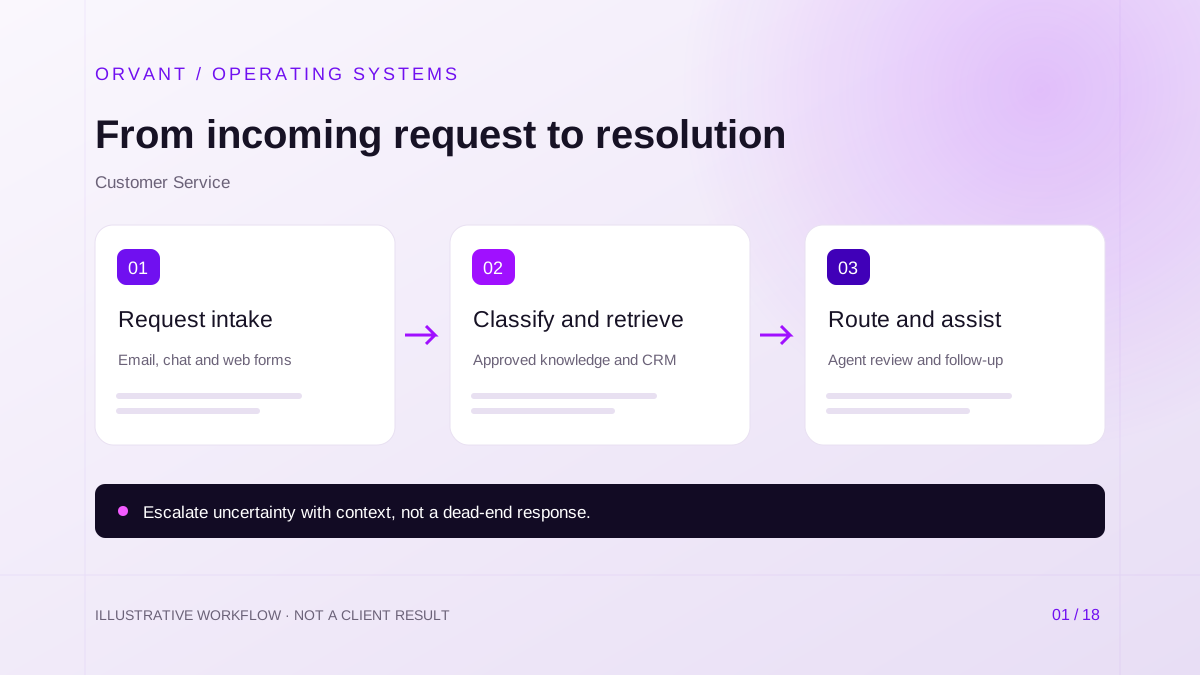
- Receive the message, check file types and attach a stable case identifier. Match the account through approved identifiers without treating an email address alone as sufficient authority for sensitive actions.
- Retrieve the relevant order, CRM context and policy version. Ask the model for a proposed category and response with source references, not an unrestricted instruction to act.
- Apply business rules, present the proposed action to the responsible agent and update the case after approval. Store the decision, source version and any exception.
Integrate through supported CRM and help-desk APIs. Use a deduplication key so a webhook retry does not create another case or appointment. If a dependency is unavailable, leave a visible pending task with an owner and a recovery route.
Hypothetical scenario: delivery-status requests
For example, a distributor receives requests asking whether an order has shipped. The workflow identifies an order, retrieves its actual status and prepares a response using the carrier event. A missing tracking number routes to fulfillment; conflicting events go to an agent. The assistant does not invent a delivery date or silently mark the case resolved.
The same integration can offer an appointment when the request concerns installation, but only after availability and customer details are confirmed. This illustrates why message generation, scheduling and business-state changes need different permission levels.
Build the human handoff first
An escalation should contain the original conversation, attempted steps, retrieved evidence and the reason for transfer. Make human contact available when the customer requests it, when identity cannot be established or when a proposed action falls outside scope. Do not restart the customer's explanation at every handoff.
Evaluate retrieval failures and malicious instructions embedded in emails as well as ordinary misunderstandings. Keep account authorization in application logic. A plausible answer from a model does not authorize a refund or a change to a customer record.
Requirements, cost and operating ownership
The implementation needs usable knowledge articles, documented interfaces, retention rules and an agreed case taxonomy. Budget for help-desk licensing, model usage, integration work, testing and ongoing review. Appoint someone to update policy content and inspect exceptions after release.
Data minimization matters: a delivery-status workflow rarely needs the complete customer history. Restrict logs and redact unnecessary content before evaluation. Give support managers a way to disable an action or fall back to the original queue without losing open cases.
Evaluate a pilot against actual service work
Select one request type and compare a representative test set with how agents handle it today. Measure time spent preparing a response, correct routing, unresolved handoffs, reopened cases and errors introduced. Faster first replies are not a sufficient success measure if resolution gets worse.
Inspect failures by request type, language and knowledge freshness. Count the time required to correct wrong suggestions when assessing capacity released. Use AI document processing for attachment-heavy intake and call quality assurance when the main bottleneck is reviewing conversations.
Questions support leaders ask
Should every customer interaction start with a bot?
No. Some teams gain more from agent assistance, intake classification or follow-up coordination. Choose the intervention that addresses the measured delay and preserves an appropriate path to a person.
Can an assistant work with our existing CRM?
Potentially, if supported interfaces, licensing and permissions allow the required operations. Validate the actual fields and actions rather than assuming that an available connector covers every workflow.
What should be automated first?
Choose a frequent, well-defined request with accessible evidence and reversible actions. Bring the current queue, escalation rules and system dependencies to an ORVANT consultation before expanding the scope.
Sources and further reading
Official references checked on October 28, 2026. These describe capabilities or considerations, not results achieved by ORVANT.
- Microsoft: Unified routing
Reference for separating work classification from assignment.
Discuss the workflow behind your next improvement.
Bring your current process, system dependencies and operating constraints. We can discuss scope, feasibility, review controls and a practical pilot.
Discuss Your Project