AI Quality Assurance: Automating Call Reviews and Customer Interaction Analysis
Design evidence-backed call evaluations, calibrate scoring with supervisors and route uncertain findings for human review.

AI call quality assurance helps supervisors review conversations against an agreed rubric. Transcription, evidence retrieval and preliminary scoring can organize the work, but a generated score should not be treated as an unquestionable assessment of an employee or a customer interaction. The value comes from a review process that is easier to inspect and calibrate.
Define what quality means before scoring it
Manual QA programs can struggle with limited review capacity and inconsistent interpretations of scoring criteria. Automating the same vague rubric can reproduce those inconsistencies at a larger scale. Start by specifying observable behaviors, evidence requirements and the situations where a question does not apply.
Distinguish protocol checks from subjective judgment. A required disclosure, an incorrect account action and a coaching opportunity do not have the same consequences. Define who reviews each finding and how a supervisor or agent can challenge it before connecting AI-powered call quality assurance.
Build a recording-to-review pipeline
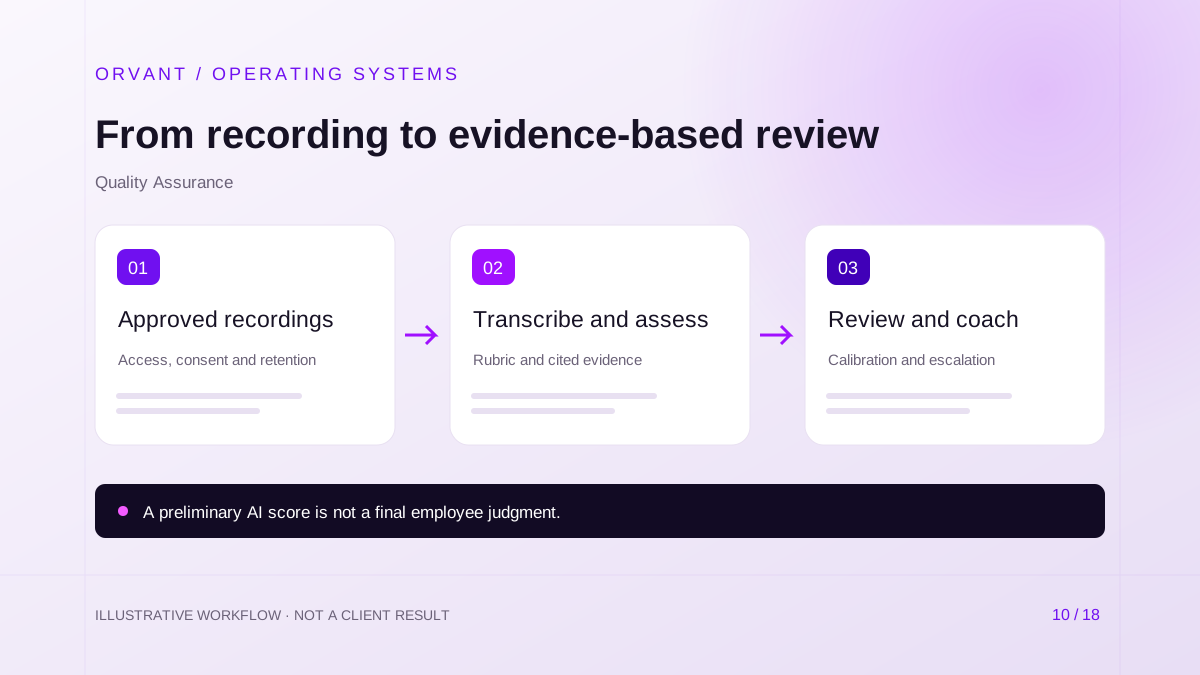
- Ingest approved recordings with contact IDs, language, client account and retention metadata. Confirm authorized access and identify missing or incomplete segments.
- Transcribe and associate speakers, then evaluate only the defined rubric questions. Return the relevant transcript passages or timestamps with each proposed finding.
- Route uncertain or consequential findings to supervisors, preserve corrections and record the final review outcome. Use the reviewed result for coaching and reporting.
Do not infer that a criterion was satisfied when its evidence is absent. A recording failure is a data-quality issue, not automatically a failed call. Keep the model version, rubric version and review status so results can be compared meaningfully over time.
What preliminary evaluations can support
AI can help locate protocol language, summarize a conversation and propose answers to rubric questions. It can flag possible issues for investigation or group recurring interaction patterns. AWS generative evaluation documentation provides an example of transcript-supported answer recommendations and handling of unclear criteria.
Claims about customer intent, tone or emotion need particular caution. Accent, background noise, speaker overlap and transcription errors can affect interpretation. Avoid presenting a sentiment label as an objective fact about either person or using it as a standalone employment decision.
Hypothetical scenario: a disclosure check
For example, a support operation requires an approved disclosure in a particular call type. The system proposes that the disclosure is missing, attaching the relevant transcript range and recording link. A supervisor listens and discovers that a noisy segment was transcribed incorrectly.
The supervisor corrects the evaluation and records the reason. That correction becomes an evaluation example, not an excuse to hide the original error. Another call lacking the disclosure can proceed through the organization's established review process with the evidence attached.
Calibrate with supervisors before wider rollout
Have multiple qualified reviewers score representative calls and resolve disagreements in the rubric. Compare the system's proposed findings against those reviewed examples, by criterion rather than only by overall score. Track unsupported flags as well as missed issues.
Include ordinary, difficult and incomplete recordings across the languages and channels in scope. Review the time spent checking false positives. A broad automated review that overwhelms supervisors with weak findings may be less useful than a narrower, well-calibrated assistance tool.
Integrate QA with the operating workflow
Connect contact IDs to the CRM, evaluation forms and coaching records through approved interfaces. Retain client boundaries in a BPO setting and limit recording access to the roles that need it. Recording, notice and retention obligations require assessment for the actual jurisdictions and use case; a technical implementation cannot promise automatic compliance.
Use contact center automation when the project also needs after-call summaries, queue coordination and CRM updates. Keep operational metrics separate from employee judgments, and refer sensitive employment uses to the appropriate HR and legal review.
Requirements and meaningful benefits
Budget for recording access, transcription, model evaluation, storage, integration and supervisor calibration. Assign owners for rubric changes, disputed evaluations and periodic re-testing. Changes to products or scripts may require updated criteria rather than a model adjustment alone.
Measure evidence accuracy, reviewer agreement, review completion and coaching preparation time. Potential benefits include more organized review coverage and clearer supporting evidence. They do not establish that every call was evaluated correctly or that a particular improvement in service performance will follow.
Common questions
Should supervisors stop listening to calls?
No. Use automation to prioritize and prepare review, especially when findings are uncertain or consequential. Preserve access to the actual recording and a documented challenge process.
Can one rubric cover every program?
Not always. Different call types, clients and service commitments can require different criteria and weights. Version those differences instead of mixing unlike scores in one report.
What should the first implementation include?
Bring a defined call type, a usable rubric and approved sample recordings to ORVANT. Establish calibration and review ownership before expanding the evaluation scope.
Sources and further reading
Official references checked on October 28, 2026. These describe capabilities or considerations, not results achieved by ORVANT.
- AWS: Generative AI performance evaluations
Documents transcript-based evaluation assistance and limitations.
Discuss the workflow behind your next improvement.
Bring your current process, system dependencies and operating constraints. We can discuss scope, feasibility, review controls and a practical pilot.
Discuss Your Project