AI Automation for Contact Centers: Customer Service, Quality and Operations
Connect contact routing, agent assistance, after-call work and quality review into one accountable operating workflow.

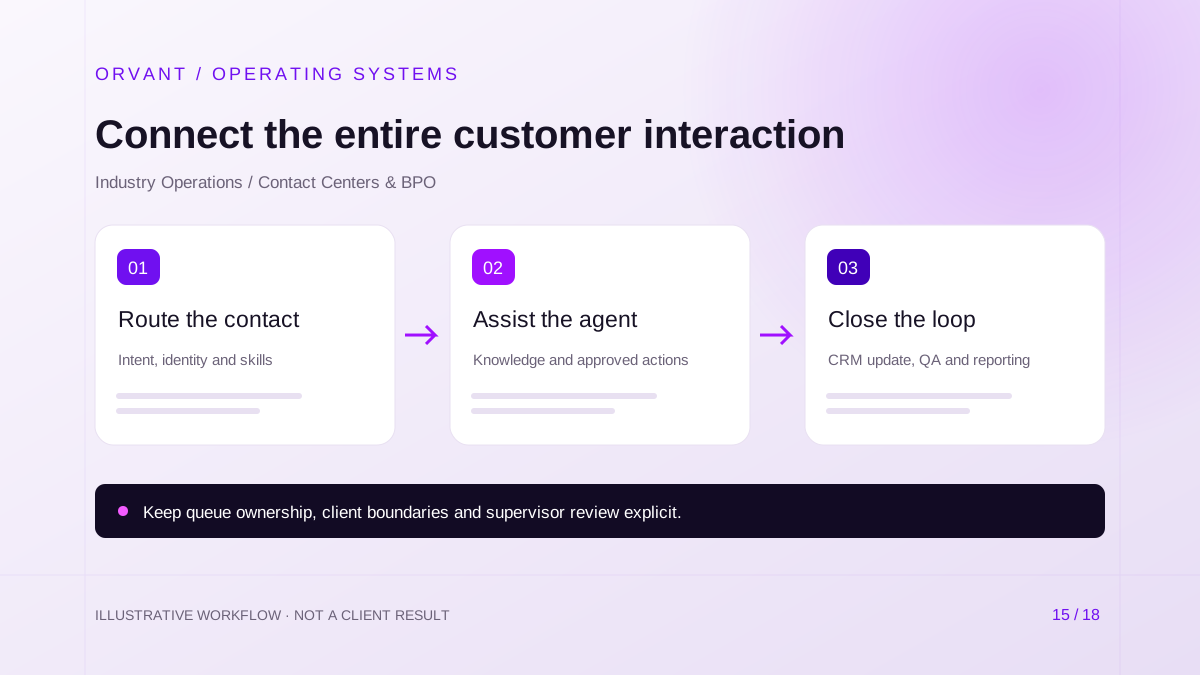
AI contact center automation connects the work before, during and after an interaction. Routing, agent assistance, disposition, CRM updates and quality review serve different operating goals. For a contact-center or BPO leader, the implementation challenge is making those pieces work together while preserving queue ownership, client boundaries and accountable supervision.
Look beyond the conversation itself
Agents may spend time looking up records before responding, then repeat information in a CRM and another reporting tool afterward. Supervisors review only part of the resulting work. Adding an assistant without connecting these stages can increase inconsistency rather than remove it.
Document the full interaction lifecycle, including abandoned contacts, transfers and unresolved follow-up. For BPO operations, record the client account and contractual scope on every event. A single conversation can cross teams without authorizing cross-client access to its recording or business data.
Before the interaction: classify and route
Classify intent, language and required skills from the information the customer has actually supplied. Routing should combine those suggestions with operating rules and agent availability. A high-priority label should not silently override an identity or authorization check.
Keep rules for vulnerable customers, disputes and requests for human assistance visible. The customer service automation guide explores request classification in detail; the industry task here is coordinating it across channels, staffing and client-specific systems.
During the interaction: assist with evidence
An agent assistant can retrieve approved answers and show the policy version or account record behind them. It may prepare a suggested next step, but payment changes, account access and consequential commitments still need the designated authorization path.
Evaluate transcription and speaker attribution across the actual audio conditions, accents and languages in the operation. A transcript can omit or misattribute words. Show the agent when a suggestion depends on uncertain evidence, and preserve the ability to use the ordinary support interface when assistance fails.
After the interaction: close the operational loop
- Prepare a disposition and summary tied to the contact ID, separating stated facts from suggestions or inferred intent.
- Let the agent review the proposed CRM update and follow-up task. Apply field validation and deduplication before writing to the client's system.
- Route the interaction to the appropriate QA and reporting workflow. Preserve review status rather than presenting a preliminary score as a completed audit.
Missing recording segments, failed CRM writes and unavailable knowledge sources need their own queues. A successful summary generation does not mean that the customer's requested action was fulfilled.
Hypothetical scenario: a BPO handling retention calls
For example, a BPO supports subscription retention for several clients. The workflow retrieves only the current client's approved offers, helps the agent find the applicable process and prepares a case summary. When the customer requests a concession outside the authorized policy, it creates a supervisor task instead of drafting a new promise.
After the call, a preliminary QA check highlights missing evidence with a transcript reference. A supervisor listens before confirming a finding. The same call should not be counted repeatedly in reporting because separate transcription and CRM events arrived at different times.
Connect quality assurance to coaching
Use a versioned rubric and calibration sessions with supervisors. AWS evaluation-form documentation provides a concrete example of configurable scoring criteria. The rubric still has to reflect the actual operation and define when a question is not applicable.
Keep disputed findings, missing evidence and reviewer corrections available. Aggregate trends can support coaching and process improvement; automated scores should not become unreviewed disciplinary decisions. Explore AI call quality assurance for the scoring and calibration workflow.
Implementation requirements and measurement
The system needs approved recording access, retention rules, client-specific permissions and reliable links between contact, CRM and QA records. Review recording obligations and data handling with the responsible legal and security teams. No product feature makes that assessment unnecessary.
Pilot one queue or client program. Measure after-call handling time, corrected summaries, failed updates, customer repeat contacts and supervisor review effort. Monitor quality alongside speed; shortening a call or summary step is not useful if it creates another unresolved contact. Include telephony, transcription, model and integration costs in the evaluation.
Questions from contact-center leaders
Should automation replace agents across every queue?
No. Assistance and administrative automation may be the better starting point. Complex, sensitive or unsupported requests need a clear route to a qualified person.
Can we use one model for all BPO clients?
A common technical component may be possible, but access, knowledge, rubrics and permitted actions must remain separated by client. Validate isolation rather than relying on prompt wording alone.
Where can ORVANT help?
Discuss the interaction lifecycle and system boundaries through AI-powered quality assurance or enterprise AI implementation. Define the queue and review process before selecting automation coverage.
Sources and further reading
Official references checked on October 28, 2026. These describe capabilities or considerations, not results achieved by ORVANT.
- AWS: Create evaluation forms
Reference for designing evaluation questions and scoring rubrics.
Discuss the workflow behind your next improvement.
Bring your current process, system dependencies and operating constraints. We can discuss scope, feasibility, review controls and a practical pilot.
Discuss Your Project