AI Marketing Automation: Practical Applications for Growing Businesses
Use cleaner segments, connected CRM workflows and reviewable reporting to improve marketing operations without overstating attribution.

AI marketing automation can organize contacts, help prepare communications and connect campaign activity with the CRM. The useful question is not how many messages can be generated. It is whether the operating workflow delivers relevant communication, respects contact preferences and gives marketing and sales a shared view of what happened next.
Diagnose the gap between campaigns and customer records
Marketing teams may work with audience exports, separate campaign platforms and spreadsheets that do not reflect current CRM status. A contact who has opted out or entered an active sales conversation can remain in a nurture sequence. Reports may describe engagement without showing whether an inquiry was relevant to the business.
Map how contacts enter, change status and leave a journey. Identify which application owns consent, lifecycle stage and account ownership. Start with business process automation when synchronization and approval rules are the main issue; AI is not needed to enforce a known suppression rule.
Use segmentation to answer a business question
Define segments around explicit business context, such as the service requested, organization type or stated implementation need. Microsoft's Customer Insights segmentation documentation illustrates rule-based segments. An AI classification can supply a proposed topic, but it should retain the supporting message and a way to correct it.
Avoid treating inferred interests as established facts about a person. Validate whether the available records support a useful distinction before introducing smaller segments. Missing or stale fields can make a sophisticated audience model less useful than a simple list with reliable ownership.
Build a connected campaign workflow
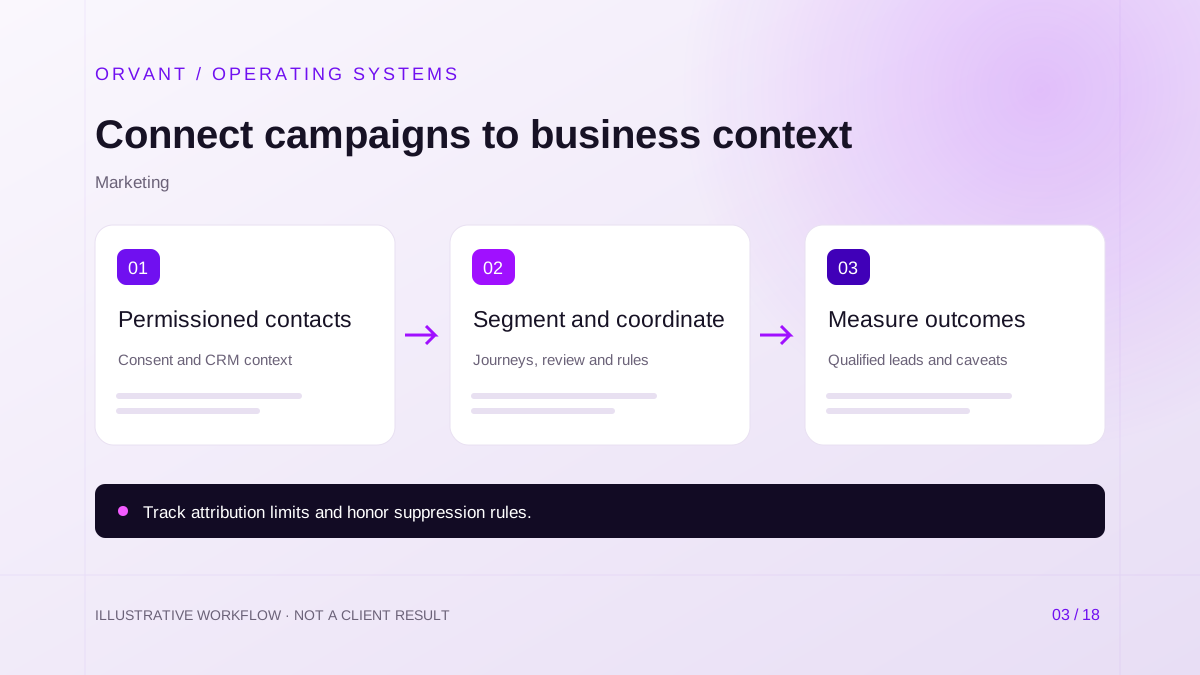
- Receive a permissioned contact or business inquiry, deduplicate it and synchronize its current preferences and CRM stage.
- Apply the approved segment and journey rules. Use AI where interpretation or a draft is helpful, then run content and audience checks before a communication is released.
- Record delivery and response events against stable identifiers. Update sales tasks and stop or change the journey when the business state requires it.
Do not let a drafting assistant decide who has consented. Give campaigns clear re-entry, exit and frequency rules. Retries should not send the same message several times when a webhook or integration becomes available again.
Personalization and lead nurturing
Personalization is most useful when it explains a relevant business problem, not when it inserts a name into a generic message. A workflow might prepare different material for a team exploring document intake and another evaluating CRM integration. Human review should check that the message matches the actual service and makes no unsupported claims.
Connect nurture activity to sales qualification without confusing engagement with purchasing intent. A pricing inquiry or a described project carries different evidence from a page view. Sellers should be able to see those distinctions rather than receiving an unexplained score.
Hypothetical scenario: an automation discovery campaign
For example, a professional-services firm runs a campaign about reducing repetitive intake work. A request mentioning document classification enters an operational-information sequence, while a request for an implementation discussion creates a seller task. The campaign pauses when the seller starts an active consultation.
AI can summarize the stated process and prepare a draft response from approved material. It must not invent a case study, claim a guaranteed efficiency gain or add a delivery timeline. A marketing owner reviews the communication and confirms that the relevant consent and suppression checks passed.
Reporting without overstating attribution
Automated reports can reconcile campaign spend, delivery events, form submissions and CRM outcomes. Keep the attribution model, reporting window and unmatched records visible. Browser consent choices, cross-device journeys, missing identifiers and offline activity can all limit what the report explains.
Separate platform-reported conversions from qualified inquiries and completed projects. AI can draft a narrative around verified figures, but the numerical definitions should come from a governed reporting model. See AI business intelligence for source-grounded analytics rather than guessed explanations.
Requirements and a pilot scorecard
Prepare documented audience fields, preference ownership, campaign templates and an approved CRM contract. Include licensing, message delivery, model usage, content review and connector support in the budget. Keep contact data out of public analytics events and restrict access to individual communication histories.
Pilot one lifecycle transition, such as inquiry-to-consultation follow-up. Measure incorrect enrollment, suppression failures, duplicate sends, preparation time and sales acceptance. Review qualified outcomes alongside engagement; more opens do not by themselves demonstrate business value.
Common questions
Should AI control campaign budgets automatically?
Only within explicitly authorized limits and a monitored decision process. Begin with recommendations and reconciled reporting rather than unrestricted changes across channels.
Can automation repair poor contact data?
It can help identify missing or inconsistent fields, but somebody must own correction and source precedence. Inferring an unsupported value can make the data problem harder to detect.
What should an initial consultation cover?
Bring one campaign workflow, its CRM handoff and the reporting definitions. ORVANT can help define the integration and review requirements before adding automated interpretation or personalization.
Sources and further reading
Official references checked on October 28, 2026. These describe capabilities or considerations, not results achieved by ORVANT.
- Microsoft: Build segments in Customer Insights
Product-specific reference for rule-based business audience segmentation.
Discuss the workflow behind your next improvement.
Bring your current process, system dependencies and operating constraints. We can discuss scope, feasibility, review controls and a practical pilot.
Discuss Your Project