AI in Healthcare Administration: Automating Non-Clinical Workflows
Improve scheduling coordination, administrative requests and record routing while maintaining privacy boundaries and clinical escalation.

Healthcare administrative automation supports the coordination work around care: scheduling requests, document routing, administrative inquiries and internal handoffs. It is not a substitute for diagnosis, treatment decisions or clinical triage. The first implementation should define that boundary in its workflow, permissions and escalation behavior, not only in a disclaimer.
Identify a non-clinical operating problem
Administrative staff may move between scheduling tools, document repositories, billing systems and inboxes to answer a request. Missing information creates repeated calls, while unclear task ownership leaves patients or referring offices waiting. A model that generates a reply does not resolve those coordination failures by itself.
Choose a task with an identifiable administrative owner and clear completion criteria. Map the minimum information needed, the systems involved and the point where clinical staff must take over. Business process automation may address a predictable routing problem without requiring AI interpretation at all.
Suitable workflows and limits
Scheduling coordination can collect an appointment preference, check authorized availability and route the request for confirmation. Document intake can classify an administrative form and identify missing fields. Internal assistants can retrieve approved operating procedures, such as where a staff member should route a request.
Keep medical questions, reported symptoms and uncertain urgency on an appropriate human escalation path. Do not let a general assistant decide that a patient can safely wait. Separate administrative record organization from interpretation of clinical history or treatment recommendations.
A request-to-coordination workflow
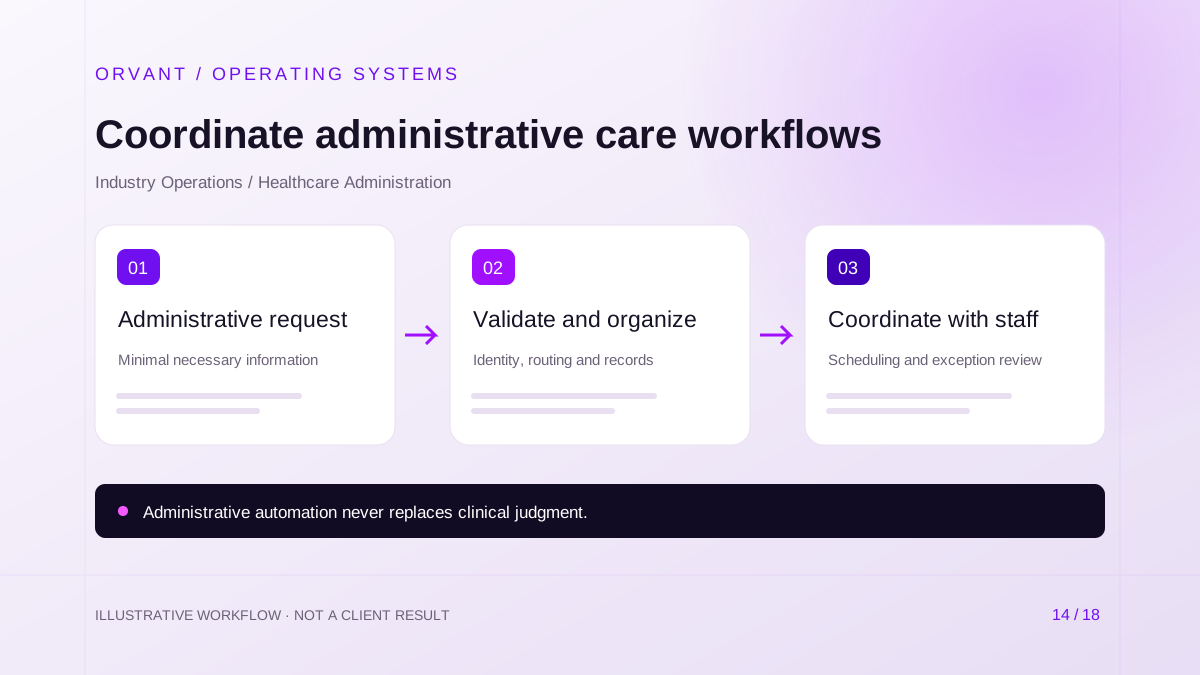
- Receive the request through an approved channel, verify the required identity context and collect only the information needed for the administrative task.
- Validate required fields, match the relevant record and apply routing or scheduling rules. If AI classifies free text, require it to flag uncertain or potentially clinical content.
- Create a reviewable staff task or propose an available slot through authorized interfaces. Record the actual confirmation and any unresolved exception.
A requested appointment time is not a confirmed booking. A processed document is not proof that the receiving department reviewed it. Preserve those distinctions in both the interface and the system status.
Hypothetical scenario: coordinating a referral package
For example, an administrative team receives a referral-related package through its approved intake system. The workflow checks whether the expected administrative documents are present, links them to the authorized record and sends missing-item tasks to the appropriate staff member.
It does not determine whether the referral is clinically appropriate. If the message includes a medical question or potentially urgent symptoms, the process follows the organization's defined escalation route rather than generating reassurance. The relevant staff review the package before scheduling or another consequential action.
Privacy and U.S. regulatory considerations
Determine which obligations apply to the organization and its vendors before selecting a processing environment. HHS cloud-computing guidance addresses risk analysis and business associate agreements for applicable HIPAA arrangements. A signed agreement alone is not a complete technical or operational compliance program.
Review permitted uses, data retention, access controls, incident responsibilities and subcontractors with qualified legal, privacy and security personnel. An administrative label does not make patient information non-sensitive. No ORVANT workflow or model feature should be described as automatically ensuring HIPAA compliance.
Integration and maintenance requirements
Confirm vendor-supported interfaces, licensing and approval for the intended systems. Establish who owns appointment status, document acceptance and administrative completion. Restrict service accounts and prevent patient information from entering public analytics events or general-purpose debugging logs.
Budget for interface work, evaluation, staff training, ongoing vendor costs and privacy review. Use appropriately de-identified or controlled test material. The document processing guide and IT support guide offer related patterns for evidence and permissions.
Measure a pilot around safe coordination
Pilot a single non-clinical task with staff review. Test wrong-record matches, missing fields, duplicate requests, unavailable systems and messages requiring clinical escalation. Track correct routing, staff preparation time, unresolved work and the effort needed to correct the system.
Potential benefits include less repetitive intake and clearer ownership. Do not measure success only by fewer staff interactions: some interactions are necessary safeguards. Review the operating outcome and privacy controls together before expanding the process.
Common questions
Can an assistant answer a patient's medical question?
Not within this administrative scope. Route it to an approved clinical channel and make the boundary clear in the experience.
Can we send patient documents to any AI provider?
No assumption of permission should be made. Assess the data, contractual arrangements, applicable obligations and technical controls for the specific provider and use case.
What should an ORVANT consultation establish?
Define a non-clinical workflow, its data boundary, integrations and accountable staff owner. Discuss enterprise AI implementation only where interpretation is needed within those controls.
Sources and further reading
Official references checked on October 28, 2026. These describe capabilities or considerations, not results achieved by ORVANT.
- HHS: HIPAA and cloud computing
Addresses cloud responsibilities, risk analysis and business associate agreements for applicable organizations.
Discuss the workflow behind your next improvement.
Bring your current process, system dependencies and operating constraints. We can discuss scope, feasibility, review controls and a practical pilot.
Discuss Your Project