AI Automation for Insurance Companies: Practical Use Cases and Workflows
Explore intake, document handling and agent support while keeping underwriting, coverage and claims decisions under appropriate governance.

AI insurance automation can help organize submissions, service requests and document-heavy case work. Its operational value is different from deciding coverage, pricing risk or settling a claim. For an insurance team, the project boundary should specify which preparation tasks can be assisted and which decisions remain with authorized professionals under applicable governance.
Start with the insurance service file
An inquiry may move through an agency inbox, document portal, policy administration system and a service queue. Staff repeatedly identify the account, check whether the required forms arrived and ask for missing information. An incomplete package can be passed to another team before anyone recognizes the gap.
Choose one operating process and map its case identity, required documents and responsible reviewer. Determine whether ORVANT's enterprise AI implementation or a simpler workflow integration fits the work. A deterministic completeness check may be more appropriate than a generated assessment.
Operational applications with clear boundaries
Document intake can classify forms, extract agreed identifiers and associate files with a submission. Service-request handling can identify the stated topic and route it to an agent. An internal assistant can retrieve approved process guidance and prepare a source-backed summary for the person handling the file.
Case coordination can track missing documents, outstanding tasks and ownership across teams. Customer communications can use approved templates and current case status. Do not allow a summary or classifier to silently determine coverage, establish fraud or decide whether a claim should be paid.
Design the intake-to-review workflow
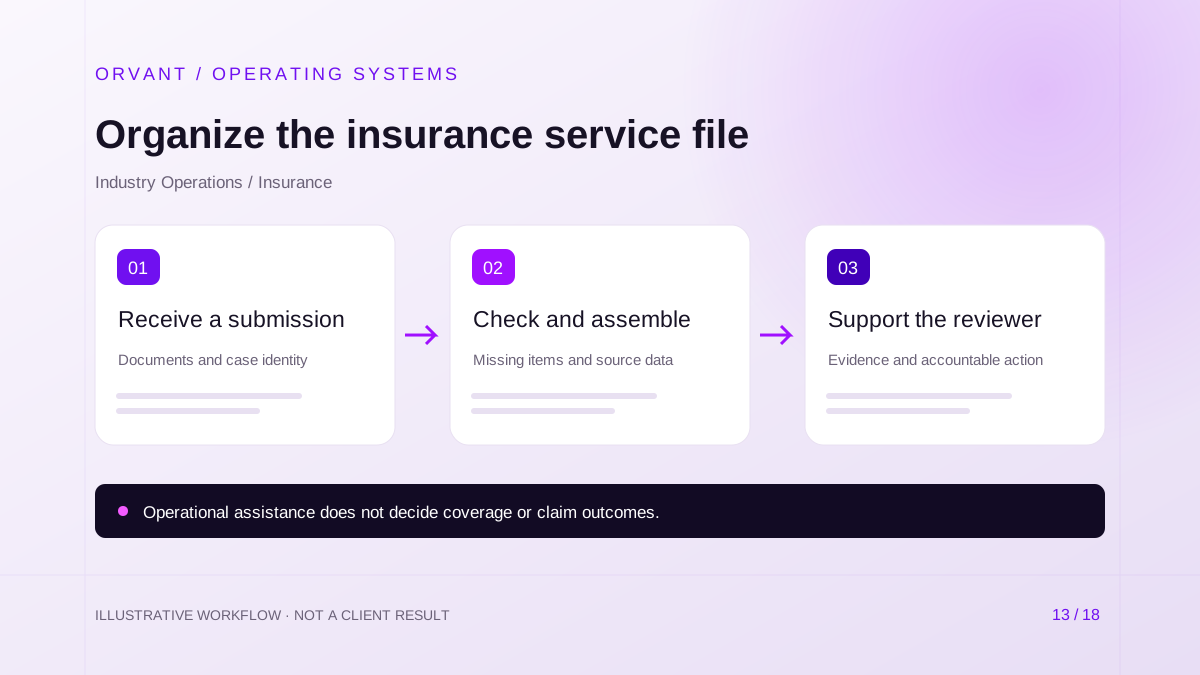
- Receive the package through an authorized channel and identify its case and document types. Preserve the original files, access rules and version history.
- Check required information against the defined workflow. Extract permitted fields and flag inconsistencies without filling gaps with assumed facts.
- Assemble a review package, assign the responsible agent or specialist and track the next approved action. Synchronize status with the relevant insurance system.
Use stable case IDs and exception queues for unmatched documents. When a file is amended, retain what changed and which review relied on the earlier version. AI document processing explains why extraction and verified business meaning must remain separate.
Hypothetical scenario: an incomplete service submission
For example, a commercial insurance team receives a service request with several attachments. The workflow identifies an expected form that is missing and a document containing an inconsistent business identifier. It creates a preparation task and drafts an approved request for clarification.
An agent reviews the package before it reaches the specialist. The automation does not infer that the customer is ineligible, that a claim is fraudulent or that a term applies. The purpose is to make the responsible person's evidence easier to inspect, not to disguise an automated decision as administrative support.
Governance is part of the operating design
The NAIC insurance AI topic provides industry governance context. Requirements and supervisory expectations can depend on the state, entity and use case; an implementation partner should not present general AI tooling as automatic compliance.
Identify the accountable insurance, legal, privacy and security owners. Review vendor access, data handling, record retention and customer communication rules for the actual workflow. Separate operational indicators from sensitive decisions and retain a process for questioning or correcting output.
Integration and maintenance requirements
Confirm interface access to policy, service and document systems rather than assuming that a generic CRM connector is sufficient. Define which application owns case status and who may alter it. Restrict information by role and prevent one customer's documents from appearing in another customer's retrieval context.
Include representative redacted files, integration testing, review capacity, licenses and maintenance in the project budget. Document layouts and internal procedures change. Assign responsibility for updating the extraction rules, knowledge sources and exception handling after release.
Evaluate preparation quality before expanding scope
Pilot one document package or service-request type in shadow mode. Measure document matching, completeness checks, preparation time and the reviewer's correction effort. Include confusing attachments, inconsistent identifiers and cases that should be escalated immediately.
Potential benefits include less repeated document handling and clearer outstanding work. Those benefits must be demonstrated locally; they are not evidence of better coverage or claims decisions. Customer service automation and call QA can extend the operational workflow with their own controls.
Common questions
Can AI decide whether a claim is valid?
That is a consequential decision outside this administrative design. It requires a separate assessment of authority, evidence, fairness, review and applicable obligations.
Can agents use an assistant to interpret any policy?
Use approved sources and preserve the policy version and context. Unsupported or ambiguous interpretations should reach a qualified person rather than be presented as definitive guidance.
What is a suitable first consultation?
Bring a bounded submission or service process and the systems it touches. ORVANT can discuss business automation that improves preparation without taking over regulated decisions.
Sources and further reading
Official references checked on October 28, 2026. These describe capabilities or considerations, not results achieved by ORVANT.
- NAIC: Artificial intelligence in insurance
Industry governance context; state requirements and applicability require separate review.
Discuss the workflow behind your next improvement.
Bring your current process, system dependencies and operating constraints. We can discuss scope, feasibility, review controls and a practical pilot.
Discuss Your Project